
Which supplement side effects in pregnant women in Switzerland?
Quick summary
In Switzerland, only three supplements are recommended for every pregnant woman: folic acid (400 µg/day before the 12th week), vitamin D (600 IU/day) and iodine (200 to 250 µg/day). Any other supplement requires medical advice.
Key facts
Key points
- Only three supplements are systematically recommended for pregnant women in Switzerland: folic acid 400 µg/day until the 12th week, vitamin D 600 IU/day and iodine 200 to 250 µg/day via iodised cooking salt (FOPH).
- Iron is only taken after a blood test confirms a deficiency (low ferritin and haemoglobin). The Watt et al. (2025) meta-analysis finds no benefit to supplementing a woman who is not deficient.
- Vitamin A as retinol can cause foetal malformations (teratogenic effect) above 3,000 µg RE/day (≈ 10,000 IU), with documented effects on the face, heart and brain.
- Stacking several “pregnancy-special” supplements exposes the baby to an excess of calcium in the blood and to thyroid disorders: cases reported to the Anses nutrivigilance scheme (2024 opinion).
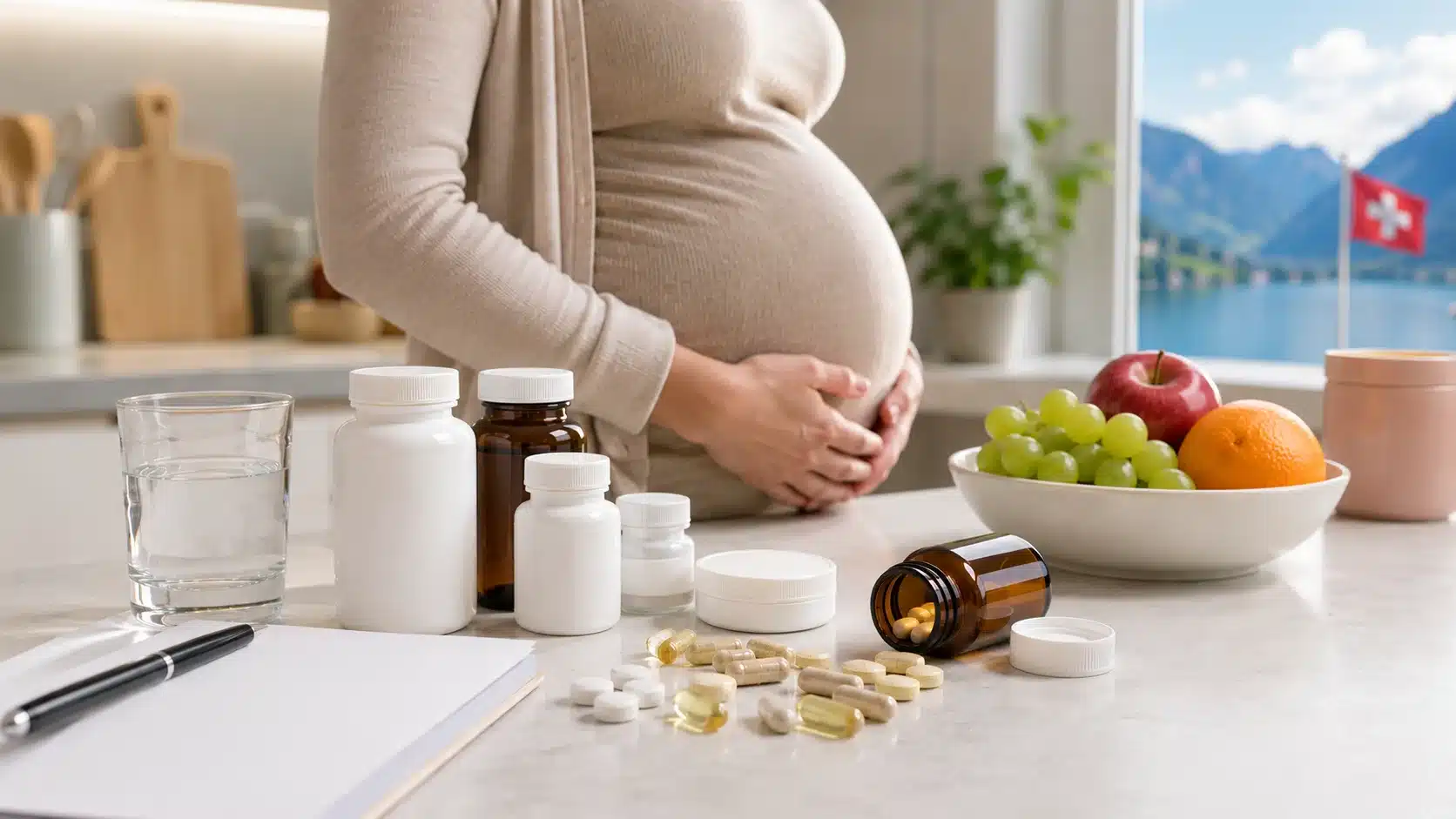
According to the Swiss Folic Acid Foundation, 15 to 20 children are born each year in Switzerland with spina bifida. This neural-tube closure anomaly can largely be prevented by 400 µg/day of folic acid before the 12th week of pregnancy. During pregnancy, a food supplement is neither trivial nor accessory: the priority is targeted, quantified supplementation, never cumulative. Knowing the side effects of food supplements is essential in pregnant women. High-dose vitamin A, excess iodine and certain plants can cause foetal malformations or thyroid disorders in newborns.
Which food supplements are recommended or contraindicated for a pregnant woman in Switzerland?
Which supplements can a pregnant woman take safely in Switzerland?
Only three supplementations are validated by the Swiss health authorities for a normal pregnancy in the mother-to-be: folic acid, vitamin D and iodine[3]. Folic acid, sold as a tablet or capsule, is taken at 400 µg/day in synthetic form, ideally during the preconception period (3 months before conception) and until the 12th week of pregnancy. This recommended dosage supports the baby’s development and plays a key role in preventing neural-tube anomalies in early pregnancy. The Swiss Folic Acid Foundation points out that a healthy, varied and balanced diet only delivers 200 to 250 µg/day of natural folates: only half of the doubled needs during pregnancy[2]. Vitamin D is recommended at 600 IU/day by the Federal Nutrition Commission to ensure a sufficient intake. At this dose, more than 97% of the population reaches the target blood level of 50 nmol/L, including pregnant women[4]. Iodine mainly comes through Swiss iodised cooking salt (enriched to 25 mg/kg since January 2014). The FSVO observes in its 2019 Swiss Nutrition Bulletin that pregnant women do not consume enough of it. A targeted intake of 200 to 250 µg/day is therefore recommended (WHO, taken up by the federal authorities)[1].
Which food supplements are contraindicated during pregnancy?
Supplements containing preformed vitamin A (retinol, retinyl palmitate), berberine, or oestrogen-mimicking plant extracts are formally contraindicated in the mother-to-be, both during pregnancy and during breastfeeding[8]. Vitamin A becomes toxic to the foetus (teratogenic effect) above 3,000 µg RE/day, i.e. about 10,000 IU. This limit must not be exceeded in women who are pregnant or who might be[9]. Iron without a biological work-up is not part of routine supplementations, contrary to what is suggested by certain pregnancy vitamin brands such as Elevit, Burgerstein or Natalben Plus, widely present on the Swiss market. The Watt et al. meta-analysis published in February 2025 in Family Practice found no clinical benefit in pregnant women who are not deficient[5], and the Cochrane Finkelstein 2024 review concludes that systematic supplementation reduces maternal anaemia but does not bring long-term clinical benefit in women who are not deficient[6].
What are the risks of vitamin or mineral overdose during pregnancy?
Why is high-dose vitamin A teratogenic for the foetus?
Preformed vitamin A induces, above the teratogenic threshold, a specific malformation syndrome affecting the central nervous system, the heart and the face[9]. Excess vitamin A acts directly on the genes that drive embryonic development from the very first weeks, which disrupts the formation of organs. The Zamil et al. study published in 2021 in Dermatology Practical & Conceptual analysed 49 “skin health” and acne supplements sold online. 26 of them (53%) contain vitamin A. Three are judged probably teratogenic, and four exceed daily nutritional needs[9]. Retinol-based skincare products and “anti-ageing” supplements aimed at the face or skin beauty rest on the same mechanism and should be set aside. The CHUV recommends, as a precaution, avoiding eating animal liver, a food naturally rich in retinol, during the first trimester: 100 g of veal liver contains on average 10,000 to 15,000 µg RE of vitamin A according to the ANSES Ciqual table, i.e. 3 to 5 times the teratogenic threshold in a single serving[3].
Why is stacking several sources of vitamin D or iodine dangerous?
The stacking of “pregnancy-special” supplements is responsible for documented cases. These cases combine excess calcium in the blood (hypercalcaemia) and thyroid disorders in newborns (congenital hypothyroidism), reported to the Anses nutrivigilance scheme[8]. Multiplying the boxes and packs of supplements purchased in parallel exposes mothers-to-be to a silent threshold breach, each product taken in isolation seems safe, the stack is no longer so. A genetic sensitivity to vitamin D, rarely investigated: combined with too high an intake can cause an excess of calcium in the blood in the baby. If this excess persists, it leads to growth retardation, narrowing of an artery of the heart (aortic stenosis), damage to the retina and a disruption of normal cell division[12]. For iodine, stacking sources (supplements, iodine-based medicines, iodised salt) saturates the baby’s thyroid and increases the risk of goitre at birth, with an impact on the first weeks of life[8]. The Cochrane Finkelstein 2024 review confirms on iron that systematic supplementation reduces maternal anaemia, but does not bring long-term benefit in women who are not deficient, hence the value of starting from a blood test[6].
Which plants and active substances should be banned from supplements during pregnancy?
Which plants are contraindicated for uterotonic or hormonal effects?
Three families of plants are formally to be avoided during pregnancy: those that mimic female hormones, those that contract the uterus, and those that are laxative by intestinal irritation[13]. The “organic” or “natural” label on a supplement or a plant oil does not remove these risks. Plants that mimic female hormones (sage, ginseng, hops, fennel, aniseed, liquorice) contain phytoestrogens that stimulate the uterus and can cause a miscarriage. Plants that contract the uterus (fenugreek, raspberry leaf before the 3rd trimester, bearberry, pennyroyal, feverfew) trigger documented uterine contractions[13]. Stimulating laxatives (senna, buckthorn, cascara, aloe, Chinese rhubarb) irritate the intestine and can reflexively trigger uterine contractions. Traditional herbal medicine also includes bitter plants and fruits or barks considered toxic during pregnancy: mugwort, wormwood, génépi (Artemisia spp.), tansy, celandine, goldenseal, rue, yellow gentian[13].
Which stimulants and active substances should be avoided during pregnancy?
Supplements containing guarana, ginseng, mate, kola, ephedra or concentrated theine should be avoided throughout pregnancy because of their load of caffeine and stimulating alkaloids[13]. Guarana delivers 4 to 7 times more caffeine than coffee per equal weight, and caffeine crosses the placenta. Yet the baby takes much longer to eliminate it than the mother does, because their liver does not yet have the necessary enzyme. Essential oils, internally as well as on the skin or as a fragrance, are contraindicated as a precaution throughout pregnancy, whether presented as a cosmetic active or as a wellness accessory. Their concentration of active principles is far above that of a simple infusion[13]. Berberine, found in certain “blood-sugar balance” or “immunity” supplements, is explicitly advised against in pregnant and breastfeeding women: it crosses the placenta, can stimulate uterine contractions and induce kernicterus in the newborn[8]. Slimming, draining, detox, anti-water-retention or “hair-growth” products based on plants combine several risks: oestrogenic plants, digestive irritation, toxic mobilisation of placental fats.
How do you choose a food supplement suited to pregnancy in Switzerland?
Which criteria should you check on the label in Switzerland?
A supplement intended for a pregnant woman in Switzerland must display four verifiable elements, and the label must be written in French (or in the other official languages depending on the region), whatever the form: box, capsule, tablet or sachet. First, the exact form of each active; then the dose in standardised units. Next, the absence of contraindicated ingredients, and finally compliance with Swiss food legislation on food supplements (reference SR 817.022.14). For vitamin A, the label must distinguish retinol (the form at risk for the foetus) from beta-carotene (the form without documented risk). The amount must be indicated in µg RE (retinol equivalents), not just in IU[9]. For folic acid, check the dose of 400 µg and the form. Synthetic folic acid remains the standard. 5-MTHF (methylfolate, the already active form, also known as active folate) is better suited to women carrying a frequent variation of the MTHFR gene, which slows the use of classic folic acid[10]. The possible presence of animal-derived gelatin in the capsule should be checked by women on a vegan or vegetarian diet; gelatin-free prenatal vitamins are available in Swiss pharmacies. The absence of added iodine should also be checked if the diet already uses iodised salt[1]. The “pregnancy-special” claim on the box brings no particular guarantee in Switzerland. Swiss food legislation only requires a declaration to the cantonal chemist, not a marketing authorisation as for medicines controlled by Swissmedic.
Which health professional should you ask for advice before supplementing?
Before any supplementation, consulting a healthcare professional remains the rule: the gynaecologist, the midwife and the Swiss pharmacist are the three qualified contacts to give personalised advice on pregnancy in Switzerland, in line with a healthy lifestyle. The gynaecologist prescribes after the routine blood test of the 1st trimester. This blood test measures iron stores (ferritin), the vitamin D level and the proper functioning of the thyroid (TSH). They are also the only professional authorised to prescribe 4 mg/day of folic acid in case of a history of neural-tube anomaly or antiepileptic treatment[10]. The midwife provides routine nutritional follow-up and adjusts intakes in case of first-trimester nausea, a vegan diet or a multiple pregnancy[3]. The Swiss pharmacist, trained in dispensing food supplements, checks interactions and the coherence of combined doses. This contact in the pharmacy is valuable for spotting a stacking of iodine or vitamin D between several products, and their advice service remains free of charge. Self-supplementation by purchase on the internet or in supermarkets concentrates the cases reported to the nutrivigilance scheme[8].
Frequently asked questions
Can a pregnant woman take food supplements without medical advice in Switzerland?
No, self-supplementation is not advisable. Multiplying sources of vitamins and minerals has led to cases of excess blood calcium and thyroid disorders in newborns, reported to the Anses nutrivigilance scheme (2024 opinion): most often through cumulative iodine or vitamin D from several products. The FOPH, the CHUV and the Swiss Folic Acid Foundation recommend only folic acid, vitamin D and iodine, after medical advice. The pharmacist, the midwife or the gynaecologist will check the coherence of doses before any intake.
Which food supplement is banned during pregnancy?
Vitamin A as retinol above 3,000 µg RE/day is toxic to the foetus and formally contraindicated. An excess disrupts the genes that drive embryonic development and causes malformations of the face, heart and brain: isotretinoin (a vitamin A-derived medicine prescribed for severe acne) thus causes malformations in 20 to 30% of exposed pregnancies according to the sources (CRAT, Swissmedic, ANSM). Also to be avoided: berberine, plants that mimic female hormones (sage, ginseng, fennel), those that contract the uterus (fenugreek, raspberry leaf before the 3rd trimester) and stimulants (guarana, kola, ephedra).
Should iron be taken throughout pregnancy?
No, iron is only taken after a blood test confirms a deficiency. The Watt et al. meta-analysis published in February 2025 in Family Practice found no benefit to supplementing a pregnant woman who is not deficient: and an excess of iron increases the risk of gestational diabetes according to a 2022 review (Rev Bras Ginecol Obstet). The threshold used in Switzerland to talk about deficiency is ferritin below 30 µg/L or haemoglobin below 11 g/dL. The CHUV recommends diet first: meat, pulses, accompanied by vitamin C that helps absorption.
Can you take omega-3 (DHA) during pregnancy?
Yes, the WHO and the EBCOG recommend an intake of omega-3 DHA and EPA during pregnancy. The Cochrane Middleton 2018 review of 70 trials and 19,927 women showed an 11% reduction in the risk of late preterm birth and a 42% reduction in the risk of prematurity before 34 weeks in case of supplementation. The clinical recommendations published in 2024 (Cetin et al., EBCOG/ACOG guideline) set the intake at at least 250 mg/day of DHA+EPA for any woman of childbearing age, with 100 to 200 mg/day of DHA in addition from the start of pregnancy. Eating fish 2 to 3 times a week, avoiding tuna, swordfish and halibut (mercury), generally covers these needs.
When should folic acid supplementation be started?
Ideally 12 weeks before conception, at the latest from the positive pregnancy test. The future baby’s spine (the neural tube) closes between the 21st and the 28th day of pregnancy: starting after this point no longer protects against spina bifida. The Swiss Folic Acid Foundation, the FOPH and the Canadian SOGC guideline No. 427 (Wilson 2022) recommend 400 µg/day of folic acid for any woman planning a pregnancy, and 4 mg/day in case of a family history of spina bifida or antiepileptic treatment. Supplementation continues until the end of the 12th week.
Sources and references
13 sources- FSVO (Federal Food Safety and Veterinary Office), Recommendations on iodine
- Stiftung Folsäure Schweiz, Folic acid before and during pregnancy
- CHUV, Diet during pregnancy
- Federal Nutrition Commission (FNC), Vitamin D deficiency
- Watt A. et al. (2025). The benefits and harms of oral iron supplementation in non-anaemic pregnant women: a systematic review and meta-analysis
- Finkelstein J.L. et al. (2024). Daily oral iron supplementation during pregnancy
- Middleton P. et al. (2018). Omega-3 fatty acid addition during pregnancy. Cochrane Database of Systematic Reviews
- Anses (2024). Food supplements and pregnancy, endocrine and metabolic risks linked to vitamin D and iodine
- Zamil DH, Burns EK, Perez-Sanchez A, Parke MA, Katta R. Risk of Birth Defects From Vitamin A “Acne Supplements” Sold Online. Dermatology Practical & Conceptual. 2021;11(3):e2021075
- Wilson R.D., O’Connor D.L. (2022). Clinical guideline No. 427, Folic acid and multivitamin supplements for the prevention of congenital anomalies
- EBCOG (2024). Omega-3 fatty acid supply in pregnancy, Position statement
- Swissmedic / Dr. Wild & Co. AG, Professional information Vi-De 3
- VIDAL, Can you use herbal medicine during pregnancy?