
Which drug interactions with food supplements?
Quick summary
Yes. St John’s wort, calcium, iron and vitamin K modify the effectiveness of many treatments via CYP3A4 induction, digestive chelation or pharmacodynamic antagonism — informing your doctor and pharmacist about each supplement remains the only reliable prevention.
Key facts
Key points
- A 2025 Cureus review covering 16 international studies reports 23% to 82.5% of simultaneous supplement-medicine consumption in adults aged 65 and over, with an increased risk of adverse effects.
- St John’s wort activates the PXR receptor and induces CYP3A4 as well as P-glycoprotein, which reduces the plasma concentration of immunosuppressants, oral anticoagulants, HIV antivirals and contraceptives.
- Calcium, iron, magnesium and aluminium form chelates with tetracyclines and fluoroquinolones, reducing antibiotic absorption by 40% to 90% when taken simultaneously.
- Levothyroxine, bisphosphonates and warfarin see their bioavailability or their INR modified by mineral supplements or vitamin K, requiring a 2 to 4 hour gap between intakes.
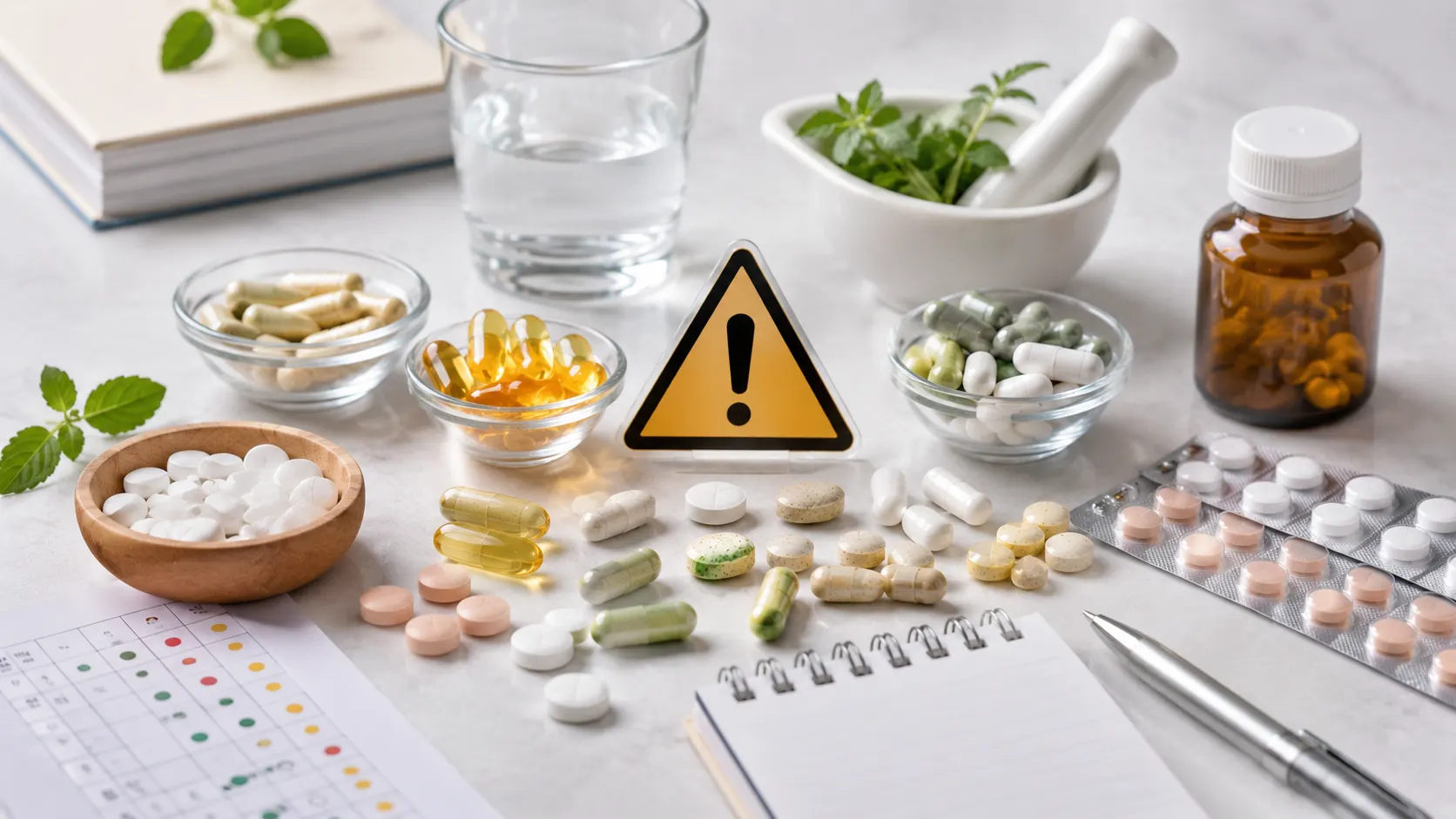
A review published in Cureus in September 2025 synthesised 16 international studies: between 23% and 82.5% of adults aged 65 and over take a prescribed medicine and a food supplement simultaneously, without always informing their doctor. In the world of the food supplement, several of these products — St John’s wort, calcium, iron, vitamin K — have a documented potential for pharmacological interaction. Understanding these mechanisms is part of the side effects of supplements that every consumer on chronic treatment must know before combining intakes.
Which food supplements are the most often involved in drug interactions?
Is St John’s wort really the best-documented interaction?
Yes, it is the best-documented drug interaction for the past twenty years. St John’s wort (Hypericum perforatum), a natural product in widespread over-the-counter use, potently and durably induces the cytochrome CYP3A4 and P-glycoprotein, which reduces the plasma concentration of cyclosporine, tacrolimus, warfarin, digoxin, alprazolam (benzodiazepine), simvastatin, antidepressants and oral contraceptives[2]. The Swiss Compendium formally contraindicates its combination with HIV antivirals, vitamin K antagonists and certain immunosuppressants: the vast majority of patients on long-term drug treatment must avoid these dangerous combinations. Its severity comes from the durable nature of the enzyme induction on the nervous system and blood circulation: the effect persists several days after stopping the course, disturbing the blood level of the associated molecules.
Which minerals and vitamins pose the most frequent problems?
Calcium, iron, magnesium, zinc and aluminium contained in multivitamin supplements (vitamins and minerals in widespread use, sometimes combined with marine collagen) reduce the absorption of tetracyclines and fluoroquinolones through digestive chelation: the Cmax and the AUC of a single 750 mg dose of ciprofloxacin drop by 85%[3] when the antibiotic is taken 5 to 10 minutes after an aluminium-magnesium antacid. Levothyroxine and bisphosphonates undergo the same phenomenon, which can reduce the effectiveness of the medical treatment. Conversely, vitamin K antagonises warfarin by restoring the coagulation factors: a daily intake above 250 µg[4] can reduce anticoagulant effectiveness and increase the risk of bleeding in patients on VKAs, particularly in case of vitamin deficiency or unbalanced diet.
How do these interactions work biologically?
What is the difference between a pharmacokinetic and a pharmacodynamic interaction?
A pharmacokinetic interaction modifies the absorption, metabolism or elimination of the medicine — calcium chelating doxycycline in the intestine is the typical example, as is grapefruit juice acting on cytochrome P450 as an intestinal inhibitor. A pharmacodynamic interaction modifies the biological effect without touching the concentration: vitamin K does not alter the pharmacokinetics of warfarin but counters its mechanism of action by restoring the coagulation factors II, VII, IX and X[5]. The distinction guides what to do and shapes the medical advice of the healthcare professional. The first is managed by time spacing of intakes; the second requires biological follow-up (INR, hormonal dosing, digoxinaemia) or a strict avoidance, taking into account the diet and blood pressure for patients on antihypertensives.
Why are enzyme inducers like St John’s wort so feared?
Because they durably speed up the elimination of the medicine until they make it ineffective, without early clinical sign — a risk of interaction that can durably disturb a medical treatment. St John’s wort activates the Pregnane-X (PXR) receptor, which transcribes the CYP3A4 gene — the enzyme metabolising around 50% of marketed medicines according to the ANSM[6]. Induction settles in within two weeks and persists several days after stopping. Documented clinical consequences include graft rejection under cyclosporine, pregnancies under the contraceptive pill and viral rebounds under antiretrovirals; other plants such as ginkgo biloba, ginseng, green tea or goldenseal can also pose a problem by interacting with platelet function or liver metabolism. The degree of induction correlates with the hyperforin content of the extract, a parameter rarely specified on the label of supplements — hence the importance of carefully reading the leaflet.
How to avoid or manage a suspected interaction?
Which timings to respect between the intake of a supplement and that of a medicine?
The general rule from the Swiss Compendium[8] and the MSD recommendations imposes 2 to 6 hours of spacing depending on the molecule, in order to avoid taking two interacting substances simultaneously. For tetracyclines, the minimum spacing is 2 hours before or 4 hours after the intake of iron, calcium, magnesium or aluminium[7]. For fluoroquinolones, 2 hours before or 4 to 6 hours after are enough in most cases. Levothyroxine is taken on an empty stomach, 30 to 60 minutes before any supplement containing calcium, iron or magnesium. For bisphosphonates, respect at least 2 hours of delay. These timings do not apply to pharmacodynamic interactions or to enzyme inducers, which require a complete avoidance: for diuretics, antihypertensives and other molecules with a narrow margin, it remains essential to consult a healthcare professional before combining a supplement.
What to do concretely before adding a supplement to your treatment?
Three actions limit the iatrogenic risk and make it possible to check potential interactions. Firstly, inform your treating doctor and your pharmacist about all the supplements consumed, including herbal teas, natural products and plant-based preparations — the 2025 Cureus review[1] emphasises that this communication fails in the majority of consultations, particularly in case of pregnancy, breastfeeding, cancer, chronic disease or planned surgery. Secondly, read carefully the leaflet of the medicine, the 2023 ANSM Thesaurus or the Swiss Compendium to identify formal contraindications and respect the doses. Thirdly, in case of doubt about a narrow therapeutic margin (anticoagulants, immunosuppressants, antiepileptics, antiretrovirals), ask for a biological dosage before and after the introduction of the supplement. The medical advice of a healthcare professional remains the reference: for composition questions, the competent cantonal chemist service can be contacted.
Frequently asked questions on drug-supplement interactions
What are the 4 recognised levels of drug interactions?
Four levels, from absolute contraindication to simple follow-up. This hierarchy comes from the ANSM Thesaurus updated in 2023[6], a reference also used by the Swiss Compendium via VIDAL Sécurisation. Contraindication absolutely forbids the combination; the three other levels (combination not recommended, precaution for use, to be taken into account) allow co-administration under monitoring, dose adjustment or time spacing depending on the case.
Is grapefruit a food supplement or an at-risk food?
A food, but a pharmacological risk. The furanocoumarins it contains irreversibly inhibit intestinal CYP3A4 and increase the oral bioavailability of molecules such as simvastatin, amlodipine, tacrolimus or certain anxiolytics. The effect persists 24 to 72 hours after ingestion, the time for new enzymes to be synthesised by the enterocytes. A few citrus extract supplements can have a similar effect — check the leaflet and inform the pharmacist about the consumption.
Which supplements should absolutely be avoided under oral anticoagulant?
St John’s wort, high-dose vitamin K, ginkgo biloba, concentrated garlic and ginseng. The systematic review by Tan et al. published in the British Journal of Clinical Pharmacology in 2021[5] identified 78 herbs, foods or supplements capable of influencing the INR under warfarin. Direct oral anticoagulants (apixaban, rivaroxaban) are also sensitive to CYP3A4 inducers and inhibitors. Any addition of a supplement requires the prior advice of the prescribing doctor.
Should you stop your supplements during a short antibiotic treatment?
Not systematically, but respect a strict time spacing with minerals. For a course of doxycycline or ciprofloxacin, spacing the intake of the multivitamin supplement (calcium, iron, magnesium, zinc) by 2 to 4 hours[7] is most often enough to preserve antibiotic absorption. Supplements without a divalent cation (water-soluble vitamins, omega-3, probiotics) pose fewer problems. In case of doubt, ask the pharmacist for a dosing schedule adapted to the daily cycle of the treatment.
How to report a suspected interaction in Switzerland?
Through the Swissmedic pharmacovigilance system, accessible to professionals and patients. The report can be made online on the Swissmedic ElViS portal or via the pharmacist. For food supplements outside the medicine framework, the FOPH and the competent cantonal chemist receive the reports. The collective traceability of these reports feeds the Compendium updates and makes it possible to identify new risks before they become public health problems.
Sources and references
8 sources- Pharmacological Interactions Between Nutritional Supplements and Prescription Medications in Older Adults: A Comprehensive Review
- Clinical relevance of St. John’s wort drug interactions revisited
- Effects of Magnesium, Calcium, and Aluminum Chelation on Fluoroquinolone Absorption Rate and Bioavailability
- Warfarin and vitamin K intake in the era of pharmacogenetics
- Warfarin and food, herbal or dietary supplement interactions: a systematic review
- St John’s wort, king of interactions
- Tetracyclines — MSD Manual professional edition
- Hypericum Sandoz: professional information, Swiss Compendium