
Which supplement side effects in children and adolescents?
Quick summary
No. In children and adolescents, only vitamin D, iron or iodine justify a medical supplementation; overdosed multivitamins and over-the-counter melatonin create a real risk of intoxication.
Key facts
Key points
- Tox Info Suisse recorded around 1,200 enquiries linked to food supplements between 2014 and 2019, two thirds of which concerned accidental ingestions in young children.
- The Konsumentenschutz and Bern University of Applied Sciences study (published in 2025) analysed 20 products for children: 15 exceed the reference values for at least one vitamin.
- Fat-soluble vitamins A, D, E and K are stored in the liver: according to the MSD Manual, their chronic overdose causes intracranial hypertension, hepatomegaly or hypercalcaemia with nephrocalcinosis.
- The FSVO recommends daily vitamin D during the first three years of life, then 600 IU per day in winter in older children and adolescents.
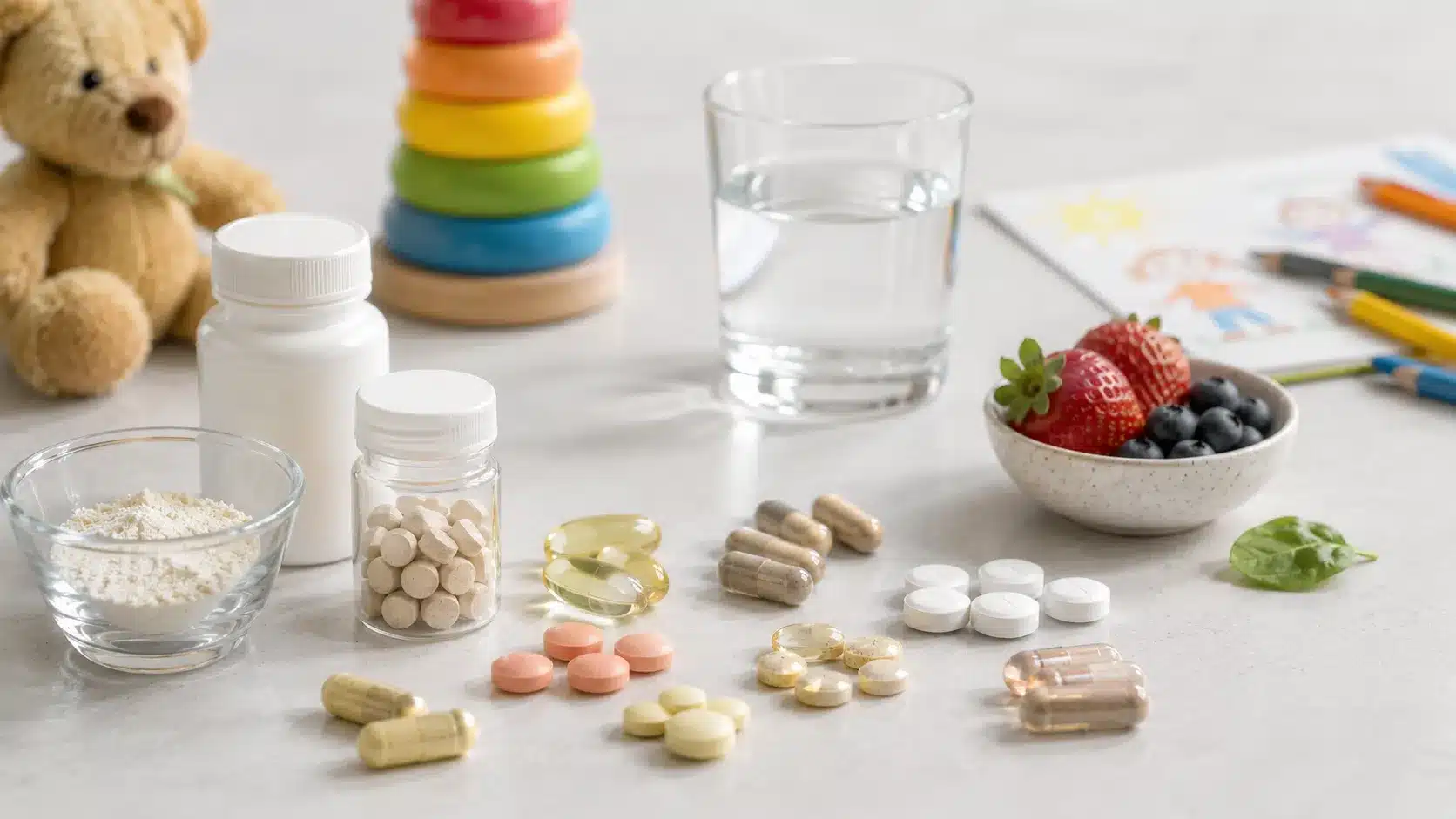
According to a joint study by Konsumentenschutz and the Bern University of Applied Sciences published in 2025, 15 out of 20 products for children exceed the reference values for at least one vitamin. In the world of the food supplement, the question of side effects of food supplements takes on a particular dimension in paediatrics. Immature metabolism, narrow tolerance margin and attractive formats such as gummies require increased vigilance, while only three molecules are officially justified in Switzerland according to the FSVO.
What are the real risks of food supplements in children?
Which vitamins present the highest risk of overdose?
Fat-soluble vitamins A, D, E and K are the most at-risk in children. Stored in the liver and adipose tissue, they can accumulate in the body and cause chronic toxicity: hepatomegaly, hypercalcaemia, intracranial hypertension[8]. Water-soluble vitamins (B and C) are eliminated through urine and present a lower, but not nil, risk; in sufficient amounts, they contribute to the production of energy, to normal energy metabolism and to the normal functioning of the immune system, which helps to reduce passing fatigue.
The vitamin A hypervitaminosis documented in children occurs from 10,000 IU per day for one to six months[8], according to the protocols of the French Society of Emergency Medicine. The therapeutic doses used against severe measles (100,000 to 400,000 IU) remain strictly supervised by a doctor. For vitamin D, Anses and ANSM raised the alert in 2021 about several cases of severe hypercalcaemia with stones or nephrocalcinosis[1] in infants exposed to food supplements over several weeks.
Why do vitamin gummies pose a specific problem?
Gummies look like sweets, often flavoured and coloured like a candy recipe, which multiplies accidental ingestion and favours overdose. The Konsumentenschutz and BFH Bern study (2025) identified 15 out of 20 products exceeding the nutritional reference values for at least one vitamin[7], sometimes several times the recommended dose for the age group. The “kid” or “junior” format sold in attractive jars in online pharmacies or on any general website provides no particular protection against this drift.
The format poses a double problem: it hides the pharmacological nature of the product and it makes voluntary excessive ingestion easier, particularly in children who perceive its taste as a treat. “Family brand” or “natural organic” marketing also maintains confusion between food and food supplement, whereas these products fall into a distinct regulatory category. In the United States, this risk was quantified for melatonin: the Centers for Disease Control and Prevention recorded around 11,000 emergency room visits for unsupervised ingestion in children aged 0 to 5 between 2019 and 2022, 47.3% of which involved gummy formats[2].
Which supplements are really justified in children in Switzerland?
From what age is vitamin D recommended?
The FSVO recommends daily vitamin D supplementation during the first three years of life[3], then an intake of around 600 IU per day in winter for children and adolescents when sun exposure is insufficient (recommendation of the Federal Nutrition Commission). It is the only vitamin for which systematic supplementation is scientifically validated in Swiss paediatrics. From the youngest age, the intake can be carried out via breast milk enriched by the mother or via a dedicated paediatric preparation according to the advice of the healthcare professional in charge of the child.
The reason is known: according to Swiss paediatric reviews, between 35 and 50% of Swiss children present hypovitaminosis D[3]. Insufficient sun exposure in winter, skin colour, clothing coverage and a low dietary intake of fatty fish explain this deficit; vitamin D contributes to good child development, bone health (in synergy with calcium) and the normal functioning of the immune system. Swiss paediatricians prescribe first and foremost an oily preparation of cholecalciferol, in one intake per day, in liquid form or as chewable tablets according to age. Anses recommends favouring medicines over food supplements for this molecule[1], because of the risk of overdose with over-the-counter products.
Do iron, iodine and vitamin K have a place in Swiss children?
Iron is prescribed in case of proven iron-deficiency anaemia, iodine if a deficiency is documented and vitamin K is administered at birth to prevent haemorrhagic disease of the newborn. Apart from these specific indications, these micronutrients must come from the diet: Switzerland uses iodised and fluoridated salt that ensures a sufficient intake for the majority of needs, supplemented by a healthy diet including vegetables, fruit, pulses, eggs and dairy products. Zinc and magnesium, also essential for normal energy metabolism and the normal functioning of the immune system, are generally covered by a varied and balanced diet without resorting to a food supplement.
The systematic review by Inchingolo et al., published in Frontiers in Pediatrics in January 2026, analysed 13 paediatric studies using the PRISMA method[4]. The authors conclude that oral supplements show measurable bioactivity, but cannot be recommended for systematic use in the absence of a documented chronic condition. The MSD Manual furthermore states that unjustified iron supplementation exposes to digestive disorders, and that a chronic excess can lead to tissue overload (secondary haemochromatosis)[8]. Supplementing a child without a documented deficiency therefore remains useless and potentially harmful.
Which supplements to avoid depending on the child’s or adolescent’s age?
Is melatonin safe in children?
No, not over the counter. In the United States, paediatric ingestions of melatonin were multiplied by 5.3 between 2012 and 2021[5], with 4,097 hospitalisations recorded by the CDC over the period[5]. In Switzerland, its use must remain supervised by a paediatrician, mainly for sleep disorders associated with neurodevelopmental disorders (autism, ADHD). Good sleep hygiene, a healthy lifestyle and a calm environment at home remain the first line of intervention before any recourse to medication.
The documented adverse effects include daytime sleepiness, agitation, headaches, abnormal dreams and, in some predisposed children, an increased risk of seizures, according to the safety summary published by Health Canada. A non-medicinal approach remains the first choice in primary sleep disorders in children, according to the Belgian Centre for Pharmacotherapeutic Information. Long-term follow-up is lacking, particularly on pubertal growth, the nervous system and hormonal maturation, which justifies systematic medical advice before any prolonged use.
Practical reflex in case of doubt
Before any supplementation in a child, ask for paediatric advice with a blood test if a deficiency is suspected. Store all supplements out of reach, like a medicine. In case of accidental ingestion, contact Tox Info Suisse on 145 (24/7 emergency number).
To avoid absolutely
Cumulating several supplements containing the same vitamin (e.g. multivitamin + separate vitamin D) is the main cause of paediatric overdoses. The presence of calcium at high doses in certain formulas increases the renal risk in case of an associated vitamin D overdose.
Sports supplements (creatine, protein powders) in adolescents: what is the framework?
Creatine is not endorsed before age 18 by most North American sports medicine societies. The International Society of Sports Nutrition (ISSN) admits its use in young athletes only under four cumulative conditions: supervised competitive training, balanced diet rich in amino acids from dairy products, pulses and eggs, knowledge of the product and respect of the recommended doses. Protein powders are rarely useful: an active adolescent covers their needs (1.0 to 1.4 g/kg/day) through three balanced meals and a substantial breakfast. Before any supplementation, consulting a professional remains the basis of a sensible approach, especially in the middle of growth and physical development.
The American Academy of Pediatrics and the NCAA defend a “food first” approach, that is to say, the priority to food. Low-quality products expose to documented contaminants: mercury, arsenic, dicyandiamide, dihydrotriazine. A Norwegian study by Svantorp-Tveiten et al. (Frontiers in Sports and Active Living, 2021) involved 1,689 high-school students[6] and highlights a correlation between use of protein supplements or creatine and risk factors for eating-behaviour disorders in adolescents[6], in particular when physical activity is accompanied by a restrictive diet or chronic oxidative stress poorly compensated by a varied and balanced diet.
Frequently asked questions on food supplements in paediatrics
Can you give food supplements to a healthy child?
No, not by default. A diversified diet covers the nutritional needs of most children. Systematic supplementation is reserved for identified situations: vitamin D during the first three years and in winter, or deficiency documented by a blood test. The FSVO emphasises that an excessive intake of fat-soluble vitamins (A, D, E, K) or minerals can cause adverse effects, and that nearly 30% of adult Swiss consumers already take at least one supplement. Self-medication in children is contraindicated by most paediatric learned societies.
What are the risks of taking food supplements in children?
Overdose, acute intoxications and digestive or neurological adverse effects. Tox Info Suisse received around 1,200 enquiries linked to food supplements, slimming products and foods for athletes between 2014 and 2019, two thirds of which concerned accidental ingestions in young children. Vitamins A, D, E and K present a risk of chronic toxicity through hepatic accumulation: intracranial hypertension, hepatomegaly, hypercalcaemia. Attractive formats (gummies, sweet syrups) increase the probability of excessive consumption.
Is it acceptable for adolescents to take food supplements?
Yes, in specific situations and under supervision. A proven deficiency (iron in menstruating adolescent girls, vitamin D in winter, vitamin B12 in a strict vegan diet) justifies prescribed supplementation. The use of creatine remains not recommended before age 16 according to the International Society of Sports Nutrition, and protein powders are rarely necessary if the dietary intake covers 1.0 to 1.4 g/kg of body weight per day. A Svantorp-Tveiten study (2021, n = 1,689 high-school students) showed a link between the use of protein supplements and risk factors for eating disorders.
What to do in case of accidental ingestion of a supplement by my child?
Call Tox Info Suisse on 145, an emergency number accessible 24/7. The national toxicology centre assesses the risk according to the molecule, the dose and the child’s weight. Its database indicates that around 1,200 enquiries were recorded between 2014 and 2019 for food supplements and similar products. The majority of paediatric cases resolve with mild symptoms; certain at-risk molecules (vitamin A, vitamin D, iron, caffeine, melatonin) may however require hospital management in case of massive ingestion.
Are multivitamins sold in pharmacy safe for children?
No, the pharmacy channel does not guarantee a paediatric dosage suited to children. The Konsumentenschutz and Bern University of Applied Sciences analysis published in 2025 showed that 15 out of 20 products for children exceeded the nutritional reference values for at least one vitamin. The risk of cumulation exists as soon as the child is already taking another supplement. The FRC recommends checking the exact composition, avoiding sweet-like formats and asking for advice from a paediatrician or a qualified dietitian before any prolonged intake.
Sources and references
8 sources- ANSM, Anses and paediatric learned societies (2021). Vitamin D in children: use medicines and not food supplements to prevent the risk of overdose.
- Freeman D.I., Lind J.N., Weidle N.J., Geller A.I., Stone N.D., Lovegrove M.C. (2024). Notes from the Field: Emergency Department Visits for Unsupervised Pediatric Melatonin Ingestion — United States, 2019-2022. MMWR, 73(9), 215-217.
- Lava S.A.G. et al. (2019). Prescription of vitamin D among Swiss pediatricians. European Journal of Pediatrics, 178(8), 1273-1278.
- Inchingolo A.D. et al. (2026). Dietary and complementary oral supplements for the management of chronic diseases in children: a systematic review. Frontiers in Pediatrics, 13, 1710200.
- Lelak K., Vohra V., Neuman M.I., Toce M.S., Sethuraman U. (2022). Pediatric Melatonin Ingestions — United States, 2012-2021. MMWR, 71(22), 725-729.
- Svantorp-Tveiten K.M.E. et al. (2021). Protein, Creatine, and Dieting Supplements Among Adolescents: Use and Associations With Eating Disorder Risk Factors. Frontiers in Sports and Active Living, 3, 727372.
- Federation of French-speaking Consumers (2025). Vitamins for children: useless, expensive and overdosed.
- MSD Manual professional edition (2024). Vitamin A toxicity.